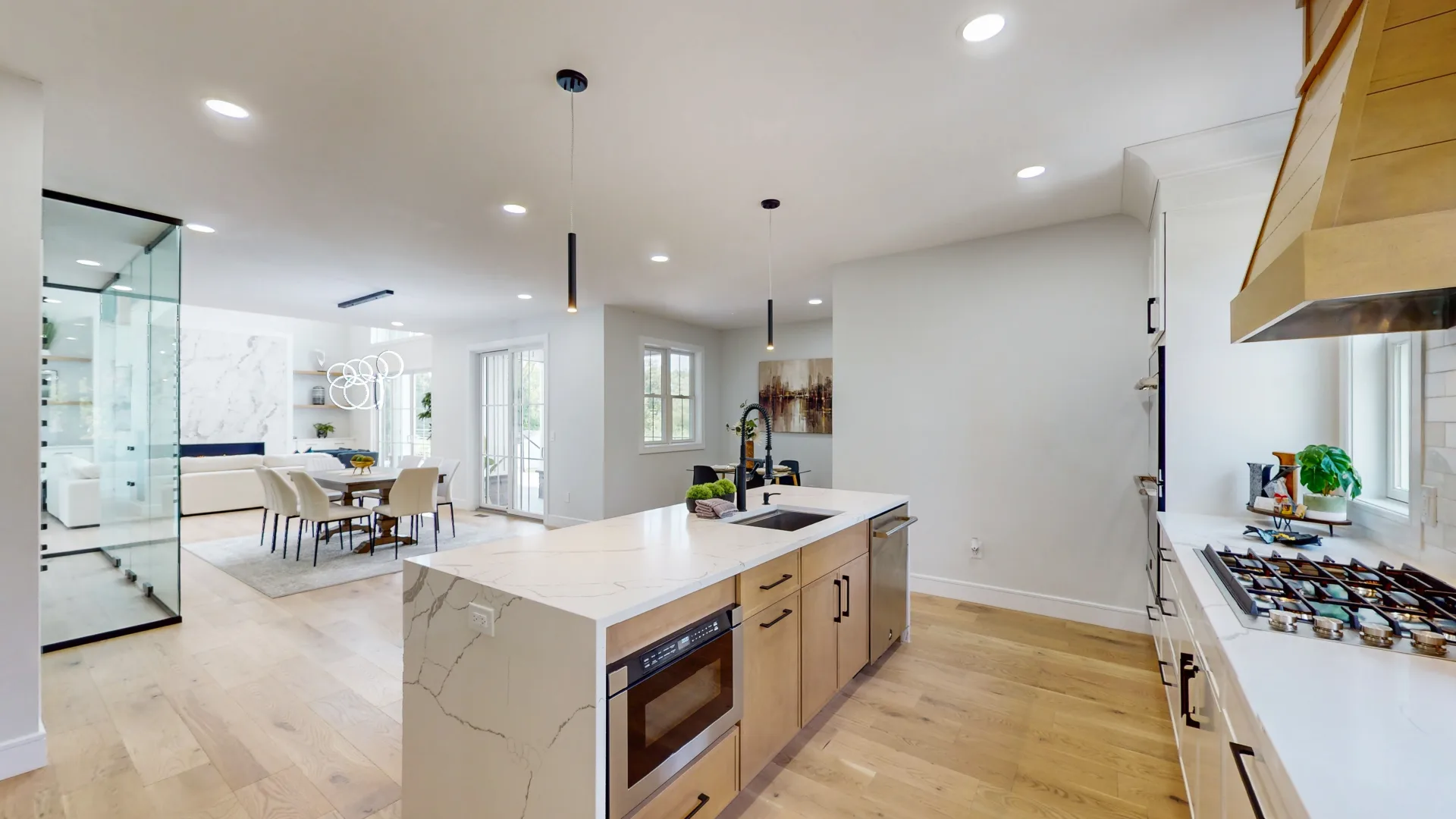
Renovating a kitchen in Bergen County, NJ is one of the highest-ROI investments a homeowner can make — but only when the project is scoped, permitted, and managed properly. After dozens of luxury kitchen builds across Englewood Cliffs, Alpine, Tenafly, Cresskill, and surrounding markets, here are the five things we wish every homeowner knew before signing a contract.
1. Cabinet lead times drive the schedule
Most homeowners think demolition starts the project clock. It doesn't. Custom and semi-custom cabinetry has a 4-8 week lead time from order to delivery, and that's the real start date.
A well-run kitchen renovation orders cabinetry at the design-finalization stage — usually 3-4 weeks before demo. By the time the boxes arrive on site, demolition, framing, plumbing, electrical, and drywall are complete or nearly complete. The cabinets install into a finished room, not an active construction zone.
If a contractor tells you they'll "demo first and figure out cabinet timing later," that's a signal you'll be living without a kitchen for an extra month.
2. Realistic budgets in this market
Bergen County kitchen renovations at luxury quality run a real range. Here's what we typically see:
- Refresh-level renovation (cabinets stay, new counters + appliances + paint): $25K-$60K
- Mid-level renovation (new semi-custom cabinetry, stone counters, mid-tier appliance package, tile backsplash): $80K-$140K
- High-end renovation (custom cabinetry, premium stone, full pro-grade appliance package, layout reconfiguration, custom millwork): $150K-$300K+
The variance comes from cabinetry tier (production vs. semi-custom vs. full custom), stone selection (quartz vs. quartzite vs. marble vs. exotic stone), appliance package (mid-tier vs. Wolf/Sub-Zero/Miele/Thermador), and whether you're moving plumbing or electrical.
3. Permits matter — especially in Bergen County
Every Bergen County town has its own building department, electrical inspector, plumbing inspector, and zoning rules. If your renovation involves moving a sink, relocating a gas line, adding circuits, or removing a wall — you need permits.
Working with a contractor who pulls permits properly means inspections are handled, the work is documented, and your home's certificate of occupancy stays clean. Working with one who skips permits to save a few weeks means you discover the problem when you sell the house and a buyer's inspector flags unpermitted work.
4. Where homeowners overspend
The most common over-budget category isn't the cabinetry or the appliances — it's the third selection round.
Most homeowners decide on cabinets, then change them after seeing the room framed. Then change the stone after seeing the cabinets installed. Then change the tile after seeing the stone. Each change costs time and money.
The fix: make selections in coordinated rounds with someone who understands how the materials interact. Cabinet door style + stone vein + tile pattern + lighting tone all work as a system. Choose them as a system.
5. The contractor's job site tells you everything
Before you hire anyone, ask to walk an active job site (with the homeowner's permission). Look for:
- Are dust barriers in place?
- Are tools and materials staged neatly or scattered?
- Are the trades on site working, or is the site empty mid-day?
- Is the homeowner's furniture in adjacent rooms protected?
- How does the contractor talk to the trades — collaborative or adversarial?
A clean, organized, respectful job site is a leading indicator of finish quality. A messy site rarely produces great finished work.
Build Better Live Happier delivers luxury kitchen renovations across Bergen County, NJ — design through certificate of occupancy. If you're considering a kitchen project, book a project consultation. We walk the space, listen to what you want, and give you an honest read on scope, timeline, and budget.
Build Better Live Happier