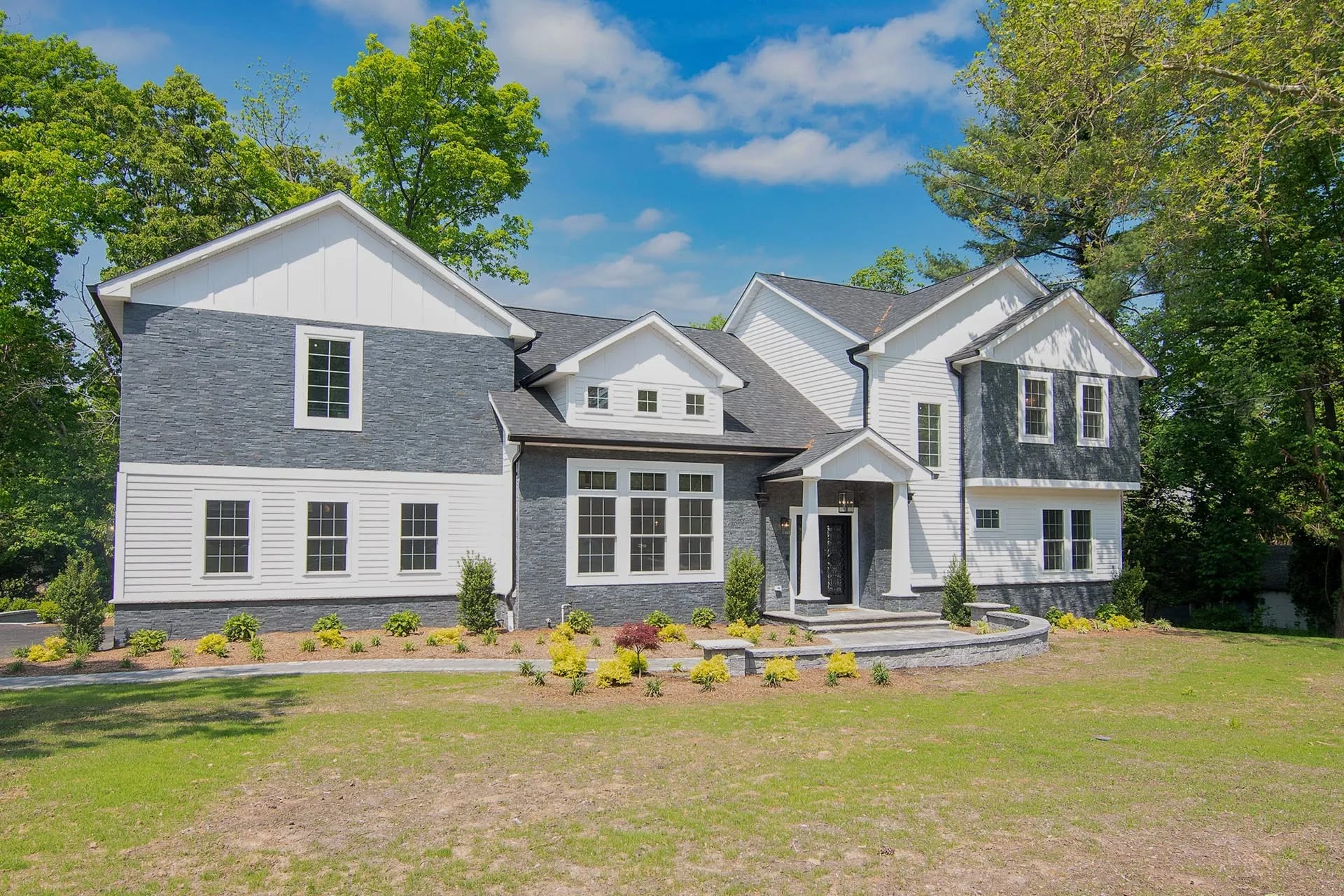
Building a custom home in Bergen County is one of the most rewarding — and most managed — projects a homeowner can take on. Done well, an 8-14 month build delivers a home that fits exactly how you live. Done poorly, it produces shortcut surprises that show up in years 2-5. Here's what the process actually looks like at the level we deliver it.
Phase 1: Site evaluation (2-4 weeks)
Before architectural design starts, the lot needs to be honestly assessed. We pull:
- A current survey
- Soil testing (especially for slab vs. crawl space vs. full basement decisions)
- Drainage analysis (where does water go on your lot?)
- Easement and setback verification
- Zoning rules for the specific town (Englewood Cliffs vs. Alpine vs. Saddle River — each has its own variance and approval process)
This is the phase where a lot you thought could hold a 6,000 sq ft home turns out to support 4,800 sq ft because of side-yard setbacks. Better to know in week three than week thirty.
Phase 2: Architectural design (8-16 weeks)
Either through our in-house design coordination or with your preferred architect, this phase produces:
- Schematic design (massing, footprint, roofline)
- Design development (room-by-room dimensions, window placement, finish concept)
- Construction documents (the dimensioned, fully specified drawings the trades build from)
Most custom-home delays happen here. Homeowners change their minds about layouts. Architects miss buildability details that only the GC catches. The fix is a tight feedback loop — homeowner / architect / GC reviewing each milestone together rather than at the end.
Phase 3: Permits and approvals (4-12 weeks)
Bergen County town approvals run from straightforward (Closter, Demarest) to highly variance-driven (Alpine, Saddle River, parts of Tenafly). If your design needs a zoning variance, this phase can extend to 6+ months including planning board hearings. Plan for it.
We handle the building permit, electrical permit, plumbing permit, mechanical permit, and any environmental review the town requires. The homeowner doesn't go to the building department.
Phase 4: Site preparation and foundation (4-8 weeks)
Excavation, foundation walls, slab, waterproofing, perimeter drainage. This is the phase where soil testing pays off — bedrock-heavy lots need different foundation systems than soft-soil lots.
Phase 5: Framing through dried-in (8-12 weeks)
Wall framing, roof framing, sheathing, windows, exterior doors, roofing membrane. By the end of this phase the home is "dried in" — weather-tight enough to start interior work regardless of season.
Phase 6: Mechanicals (6-10 weeks, parallel with later phases)
Rough plumbing, rough electrical, HVAC ductwork and equipment, low-voltage wiring (network, security, smart home), fireplace coordination. This is where the construction documents matter — vague specs produce expensive change orders.
Phase 7: Insulation, drywall, prime paint (4-6 weeks)
Once mechanicals pass inspection, insulation goes in, drywall hangs and finishes, primer coats. The home starts looking like rooms.
Phase 8: Finishes (12-20 weeks)
Hardwood flooring, tile, cabinetry, stone, trim, doors, lighting, hardware, finish paint. This is the longest phase because it's where the home's character actually lives. Cabinet lead times again drive the schedule. Stone fabrication runs 3-6 weeks. Custom millwork can run longer.
Phase 9: Final coordination (3-6 weeks)
Punch list, final inspections, certificate of occupancy, landscape coordination, final walk-through. The home needs to pass every required inspection (building, electrical, plumbing, mechanical, fire) and receive the C of O before a homeowner moves in.
How to spot a contractor who's done this before
Three questions distinguish a real custom-home GC from a remodeler trying to scale up:
1. "Can I see your last three custom-home projects from foundation to C of O?" A real custom-home GC will have multiple documented end-to-end projects. A remodeler will have remodels.
2. "Who is my single point of contact, and what's their backup?" On an 8-14 month project, you need a senior person who walks every site, knows the project, and is reachable. Not a rotating cast.
3. "Walk me through your change-order process." Custom homes always have changes. The right GC documents them with itemized costs, schedule impact, and homeowner sign-off before the work happens. Not after.
Build Better Live Happier delivers custom homes from lot evaluation through certificate of occupancy across Bergen County's premier markets. If you're considering a custom home build, book a project consultation. We'll walk your lot, talk through your vision, and give you an honest read on what's possible.
Build Better Live Happier