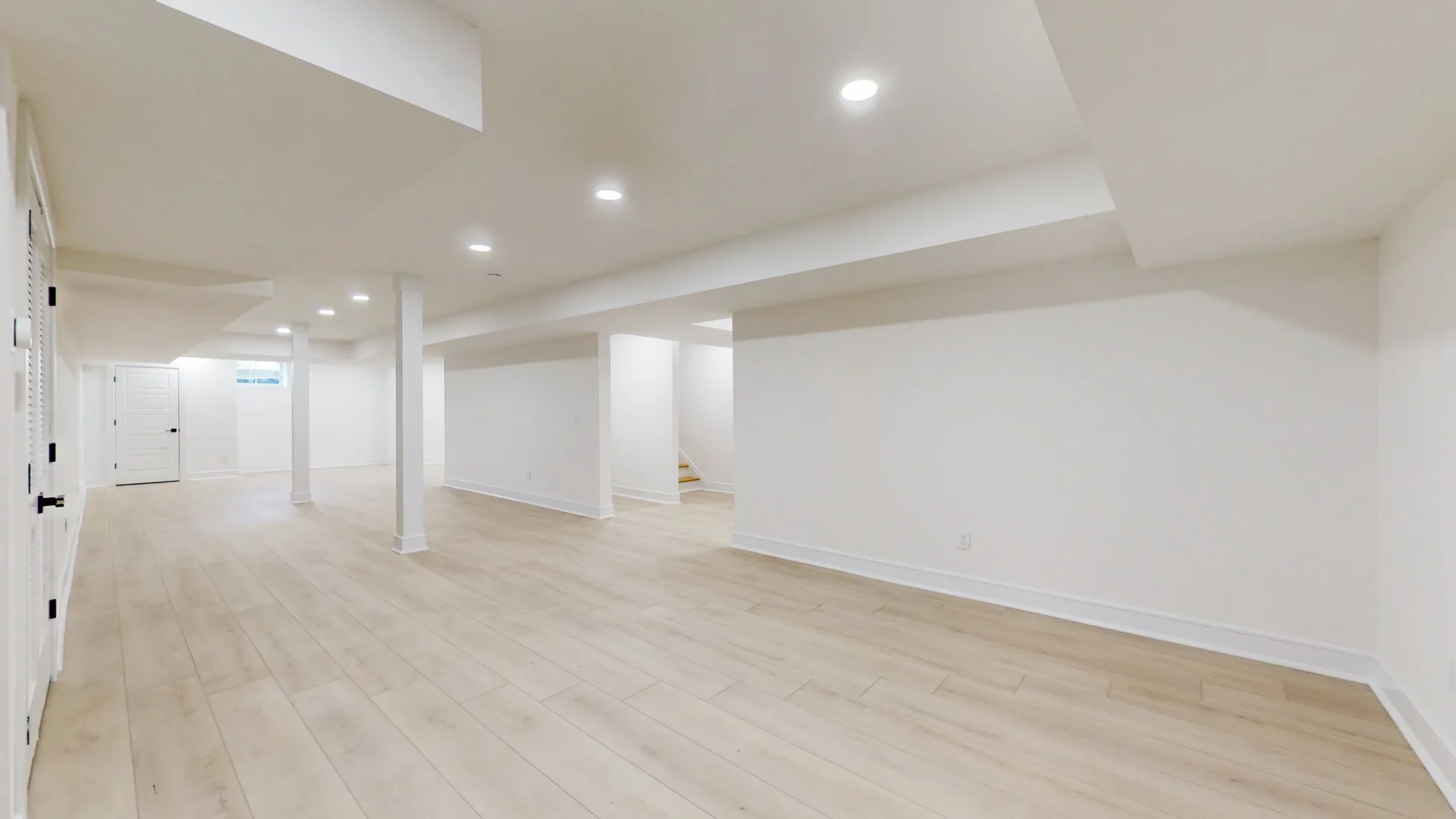
A finished basement adds usable square footage at a fraction of the cost of an addition. But basements done wrong fail in ways that aren't immediately visible. After finishing dozens of basements as in-law suites, family rooms, home theaters, and gyms across Bergen County, here are the mistakes we see most often — and the way to avoid them.
1. Skipping moisture management
Most basement-finishing mistakes happen before the framing crew even shows up. Moisture management — vapor barriers, perimeter drainage, sump pump integration, mold-resistant framing — has to be done first.
Bergen County's water table varies by town. Cliffside Park and parts of Edgewater sit on bedrock with low water issues. Tenafly, Demarest, and Englewood Cliffs have older homes where original waterproofing has aged out. Before any framing goes up, the slab and foundation walls need a proper assessment. Cracks need to be sealed. A perimeter French drain may need to be added if the home doesn't already have one.
The shortcut version: framing goes up over the existing slab, drywall goes in, carpet goes down. Two years later the carpet smells musty after a rain. The fix at that point requires tearing out the new finishes — much more expensive than doing it right.
2. Egress that doesn't actually meet code
Basement bedrooms (or any sleeping space below grade) require code-compliant egress. That means a window large enough for someone to climb out and a code-compliant well outside.
We see two failures here. First: the contractor installs a "looks-like-egress" window that doesn't actually meet the code dimensions. Second: the egress passes inspection on day one, but the well isn't properly maintained and fills with debris over the years, defeating its purpose.
The right approach: spec actual egress windows from manufacturers who certify the install (Bilco, Boman Kemp, similar), and design the well with proper drainage and a maintenance schedule.
3. HVAC as an afterthought
Existing home HVAC systems are typically sized for the home above grade, not the finished basement. Adding a fully finished basement to a home that already runs at HVAC capacity means:
- The basement is 10-15 degrees cooler in winter and warmer in summer than the rest of the house
- The system runs nearly continuously trying to compensate, shortening its lifespan
The right move: include HVAC re-balancing in the basement finishing scope. Often this means adding a dedicated zone for the basement, supplementing with mini-splits in problem areas, or upsizing the main system if a panel upgrade is also needed.
4. Lighting that reads "bunker"
Basements with low ceilings and no natural light look like bunkers when finished with single-layer recessed cans. The fix is layered lighting: ambient (recessed), accent (sconces, picture lights, under-cabinet for wet bars), and task (pendants over bar, work lights for laundry/utility areas). Dimmable zones throughout.
A well-lit finished basement reads as legitimate living space. A poorly lit one reads as a renovated cellar regardless of the finish quality.
5. Wet bars and kitchenettes spec'd too late
We constantly see homeowners decide they want a wet bar three weeks after framing is complete. Adding plumbing, drain lines, and electrical for a wet bar after rough-in is done means tearing out finished work.
Spec it day one — even if you build it later. Stub out the supply, drain, and circuit. Cap them, drywall over them, and the future wet bar is a one-week project instead of a four-week project.
Same logic applies to in-law suite kitchenettes and full bath additions in basements. Plumb for them at framing. Adding them later is always 2-3x the cost of doing it during the original scope.
Build Better Live Happier finishes basements across Bergen County to permit-ready code with full mechanical, moisture, and finish-quality discipline. If you're scoping a basement project, book a project consultation. We'll walk the space and tell you what's behind the walls before any framing goes up.
Build Better Live Happier